HCL Control: Circadian rhythms as the new standard
With HEP+, biologically effective light becomes not just feasible, but intuitive. We bring the natural course of the sun into your architecture - without complexity, but with the highest precision.
Create YOUR LIGHTING ENVIRONMENT

Well-being & Performance
Active support of the circadian rhythm to increase concentration in the office or for faster regeneration in care facilities.
Intuitive Implementation
HCL transforms from a complex special function into a simple standard application – without the need for in-depth programming knowledge.
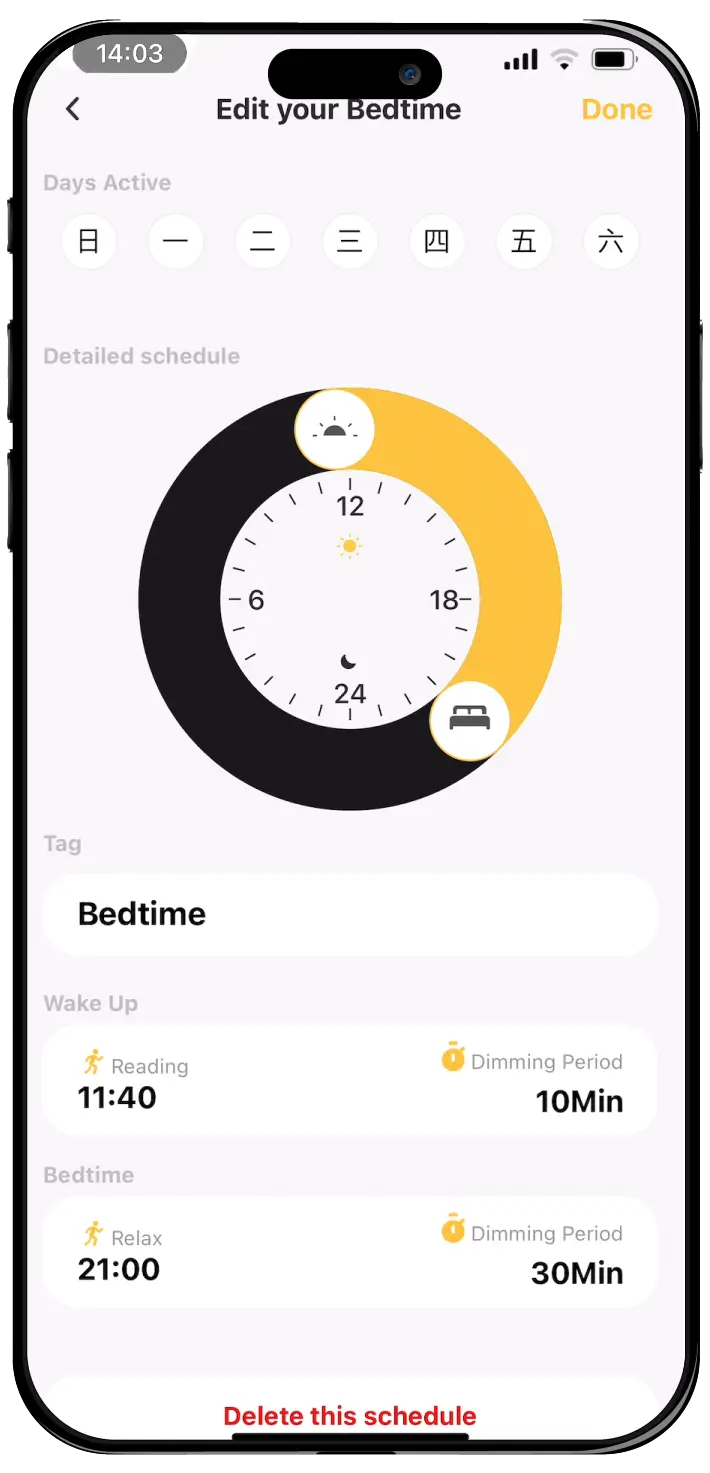
Circadian lighting profiles as an intuitive standard for health and well-being
A good day requires no intervention. Light follows the human rhythm – automatically, spectrally optimized in the 480nm range, evaluated for biological effectiveness via melanopic illuminance, and controlled so that the spectrum, not just brightness, is decisive: activating during the day, promoting regeneration at night. With HEP+, HCL evolves from a feature requiring explanation into a natural, self-evident application.
Morning
Starting the day. Stimuli recede, the body finds its rhythm. Light supports the transition – calmly.
Day
The day carries on – without demanding attention. Light remains uniform and stable, even as usage, pace, or daylight change.
Evening
The day winds down. Light becomes calmer. Transitions remain gentle.
Melanopic effectiveness
Melanopic effectiveness describes the portion of light that specifically targets receptors to suppress the production of the sleep hormone melatonin and promote the wakefulness hormone cortisol.
- Light is not just for seeing. It regulates our melatonin levels via the ganglion cells in the eye.
- HEP+ makes it possible to precisely increase the blue light component in the morning (suppression of melatonin = alertness) and radically reduce it in the evening (promotion of melatonin = regeneration).
HEP+ Advantage: Through precise constant current technology, exact light spectrum control contributes to biological hormone regulation.
Flicker-free performance & Color stability
In practice, Human Centered Lighting often fails due to poor drivers. Many Tunable White solutions flicker when dimming or change color unevenly. With HEP+, we solve this problem!
- Through precise constant current technology, the light remains absolutely stable and flicker-free, even at low dimming levels. This is crucial, as the brain perceives flickering as stress.
- More than 25 years of experience in manufacturing high-quality LED drivers form the foundation for the technical precision of HEP+.
HEP+ Advantage: The light remains absolutely stable even at extremely low dimming levels.
Questions about HCL control
What is HCL control?
HCL control stands for Human Centric Lighting. It is an intelligent lighting technology that mimics the natural course of sunlight indoors to support human biological well-being.
The most important aspects of HCL control
- The circadian rhythm (The internal clock): Our body regulates our sleep-wake cycle through hormones such as cortisol (alertness) and melatonin (sleep hormone). This cycle is significantly influenced by the color temperature and intensity of light.
- Morning: A high blue component (cool white light) suppresses melatonin and makes us alert.
- Evening: A low blue component (warm white light) promotes melatonin production and prepares us for sleep.
- Dynamic Tunable White: The heart of an HCL control system is Tunable White technology. It allows the color temperature (usually between 2,700 K and 6,500 K) to be changed continuously. An HCL control system automates this process: it “follows” a pre-programmed curve throughout the day without the user having to intervene manually.
- Melanopic Effectiveness: Not all white light is biologically effective. HCL control systems like HEP+ focus on melanopic effectiveness – the specific wavelengths that target the photoreceptors in our eyes (ipRGCs). Only when light quality and control work together precisely can the desired health effect (better concentration, deeper sleep) be achieved.
What is the advantage of circadian lighting?
The primary advantage of circadian lighting (also known as Human Centric Lighting or HCL) lies in synchronizing our internal biological clock with the natural course of daylight.
Benefits in detail
- Hormonal Regulation: Circadian light controls the release of two key hormones: cortisol and melatonin. Activation in the morning: Light with a high blue component (approx. 6,500 K) suppresses the sleep hormone melatonin and promotes the release of cortisol. This makes us alert, attentive, and efficient. Regeneration in the evening: Warm white light with reduced blue components (approx. 2,700 K) promotes natural melatonin production. This prepares the body for sleep and significantly improves sleep quality.
- Well-being & Concentration: HCL offers specific added value depending on the industry. In the office: Increased productivity and fewer sick days due to better-rested employees. In healthcare: Stabilization of the sleep-wake cycle in dementia patients or faster recovery through a strengthened biorhythm. In industry: Higher safety during shift work through artificial “light showers” that support alertness during the night shift.
Why is constant current important for HCL?
In the world of Human Centric Lighting (HCL), constant current is the technical foundation upon which all biological effectiveness is built. Without precise constant current, HCL would be nothing more than “colored light” without real added value.
Here are the critical reasons why constant current is so important for HEP+ and HCL control systems:
- Color Consistency: HCL is based on Tunable White (the mixing of warm white and cool white LEDs). LEDs are extremely sensitive to power fluctuations. The problem: If the current fluctuates, the color temperature changes unintentionally. The advantage: A constant current driver ensures that the LED emits exactly the color that was programmed. This is the only way to achieve a reproducible circadian profile that remains exactly the same over years.
- Flicker-Free: Biologically effective light should support the body, not stress it. The problem: Low-quality drivers often use simple PWM dimming (pulse width modulation), which is invisible to the eye but flickers in a way the brain can perceive. This can lead to headaches and fatigue – the opposite of HCL. The advantage: High-quality constant current drivers from HEP+ enable linear dimming. The light is absolutely calm and flicker-free, which significantly increases the acceptance of the lighting in offices or healthcare environments.
- Efficiency and Lifespan of LEDs: LEDs are semiconductors that change their resistance when heated. The problem: Without the limitation provided by constant current, LEDs would draw more and more power as they heat up until they are destroyed (thermal runaway). The advantage: The driver actively regulates the current. This protects expensive HCL luminaires and ensures that the light output (lumen) remains constant throughout its entire service life.
- Precise Control of the “Melanopic Curve”: To calculate melanopic effectiveness (the biological power of light), planners need to know exactly how much light of a specific wavelength is being emitted. The advantage: Only with constant current can brightness and light color be defined so precisely that scientifically sound statements can be made regarding the Circadian Stimulus (CS) or the Melanopic Lux value.
Is Tunable White complicated with HEP+?
Quite the opposite. The core promise of HEP+ is the radical simplification of a technology that was previously considered extremely complex. Complexity is systemically absorbed:
- Scalable spatial logic instead of individual programming: With conventional systems, every luminaire had to be laboriously addressed individually, and color temperatures had to be mixed manually. The HEP+ solution: The system thinks in terms of rooms and zones. You define the circadian logic for a room once, and the system automatically scales it to all associated devices (up to 200 per room).
- Intuitive user guidance: Previously, specialized system integrators were required for HCL scenarios. The HEP+ solution: The software interface is designed so that circadian lighting profiles can be mapped intuitively. Human Centered Control thus becomes a “natural application” that requires no lengthy explanations.
- Predefined performance parameters: The most difficult part of Tunable White is matching the drivers to the LEDs so that the color mixing remains clean. The HEP+ solution: Through adjustable constant currents and already defined parameters within the system platform, hardware and software fit together perfectly. Background protection mechanisms prevent misconfigurations that could damage the hardware.
Finally an HCL solution that works as well in practice as it does on paper.
More than 1,500 projects where well-being became a reality through HCL control.